Snake Plant Leaves Curling: Causes and Fixes
Snake plant leaves curl when the plant loses internal water pressure. Dry roots and rotted roots both cause that, which is why the fix is the opposite depending on which one you have. Check the soil three inches down before you do anything. Dry means water deeply. Wet means stop watering entirely.
That single check resolves most cases, and it matters because the two causes look almost identical from the outside. A snake plant with rotted roots cannot draw water up, so it curls exactly like a thirsty plant. Water it and you finish it off.
This guide reads the curl pattern to identify the cause, works through all seven reasons, and covers what most guides leave out: why sources disagree about the main cause, why you should only change one thing at a time, what recovery actually looks like, and when curling is simply the variety you bought.
Why guides contradict each other on this
Search this problem and you will find some sites naming underwatering as the leading cause and others naming overwatering, stated with equal confidence. Both are right, and knowing why saves you from picking the wrong fix.
Snake plants store water in thick fleshy leaves and evolved in dry regions. They handle drought well but rot quickly in wet soil. So the failure mode depends entirely on the owner.
Experienced plant keepers usually underwater them. They have heard snake plants thrive on neglect, so the plant gets forgotten for months and eventually runs dry.
New plant owners usually overwater them. They treat it like a typical houseplant, watering a little every week. The topsoil looks dry between waterings while the deeper soil never dries at all, and the roots sit wet.
Overwatering is the more common cause overall and the more dangerous, because dry roots recover in days while rotted roots may not recover at all. That is why every diagnosis below starts with the soil, not the leaves.
Diagnose the pattern first
Three checks, in this order. They take about a minute together and they narrow the cause down faster than reading any cause list.
1st: The soil, three inches down
Surface soil tells you nothing on a snake plant, because these are usually deep pots and the top dries long before the root zone does.
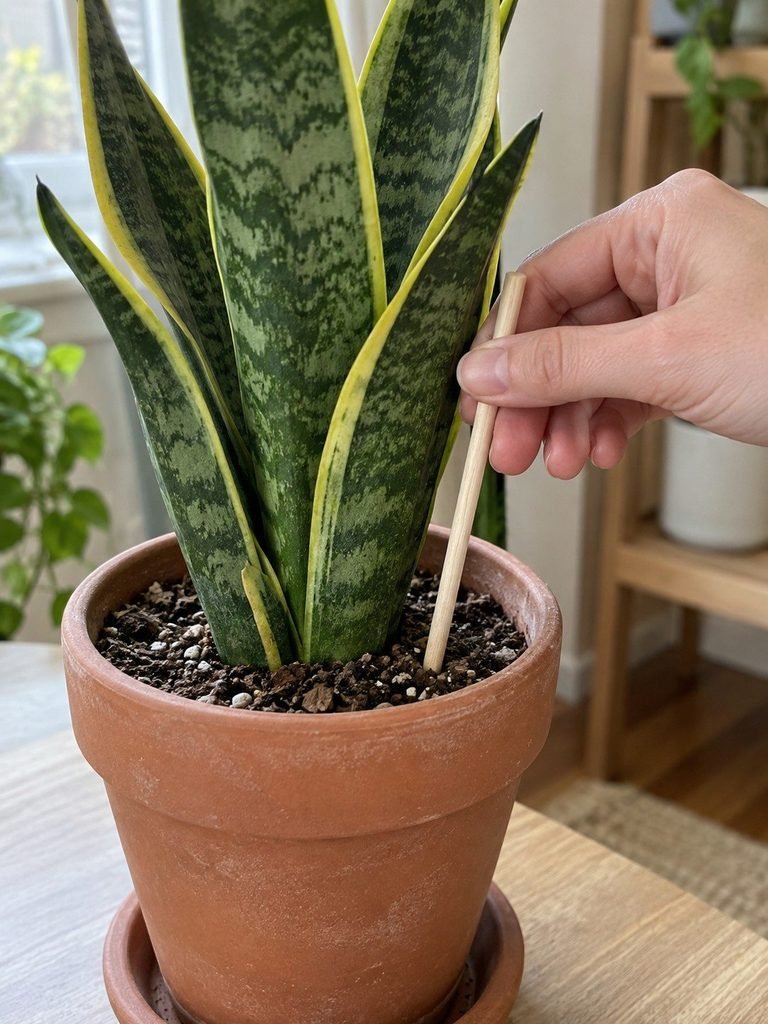
Push a finger or a clean wooden chopstick three inches into the pot, leave it ten seconds, and pull it out.
Dry, dusty, comes out clean: underwatering. The pot will also feel light and the soil may have pulled away from the sides.
Damp, dark, cool, clings to the stick, smells musty or sour: overwatering. Stop watering immediately.
Slightly damp with no smell: water is probably not your problem. Move to checks 2 and 3.
2nd: The base of the leaves
Press gently where the leaves emerge from the soil.
Firm and solid: roots are likely fine. Soft, squashy, yellowing, or leaves pull out with almost no resistance: root rot has reached the rhizome. This is the urgent version.
3rd: The shape and direction of the curl
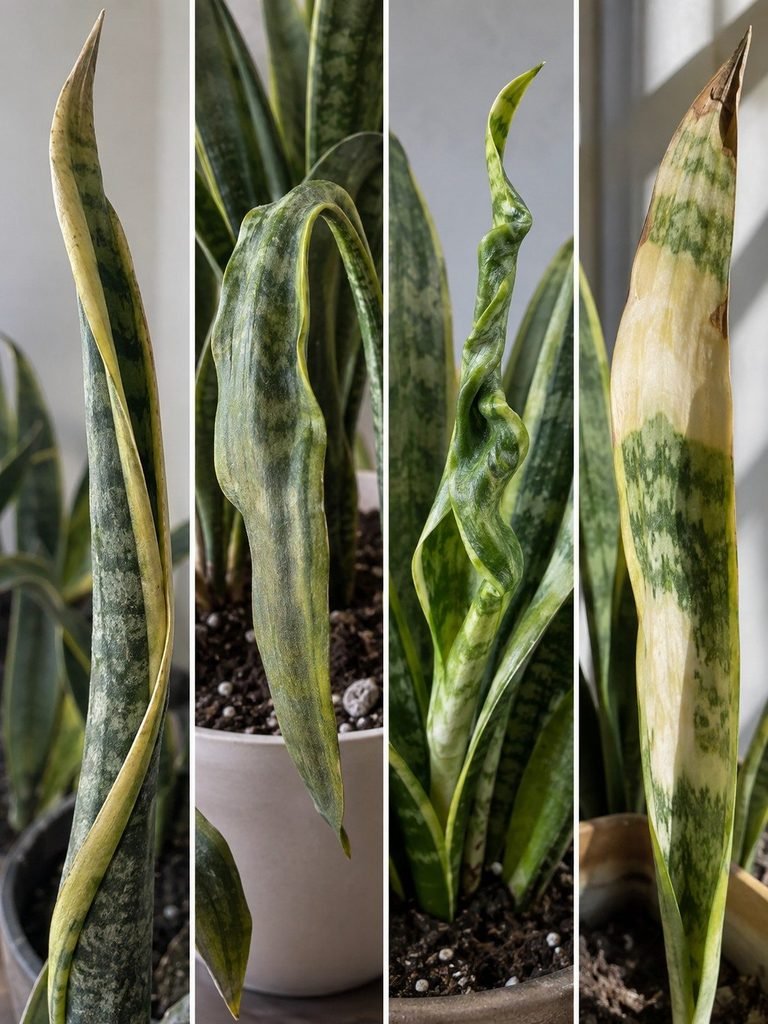
| Curl pattern | Most likely cause |
|---|---|
| Rolling inward lengthwise, both edges toward the centre, leathery and slightly wrinkled | Underwatering |
| Soft limp curling, worst at the base, with yellowing | Overwatering and root rot |
| Twisted or distorted asymmetrically, especially on new growth | Pests, usually thrips |
| Curling with pale or bleached patches | Too much direct sun |
| Curling plus brown crispy edges | Heat stress or very dry air |
| Curling with dark mushy patches, sometimes after a cold night | Cold damage |
| Only the newest centre leaves curling | Fertiliser burn or root damage |
| Even, symmetrical curl on a plant that has always looked that way | Variety, not a problem |
Which leaves are affected is a useful second signal. Outer, older leaves curling first with the centre still upright points to underwatering. Curling that starts at the base and spreads points to root rot. Only new central growth affected points to pests or root damage.
1. Underwatering
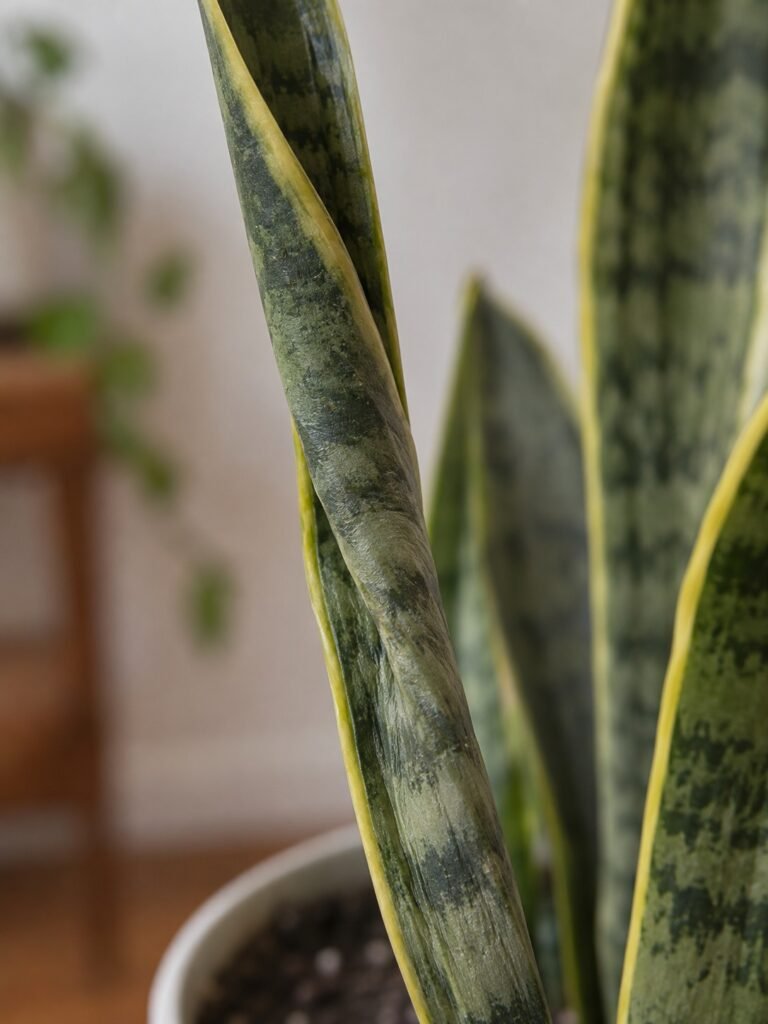
The most common cause in homes where the plant has been treated as unkillable.
Snake plant leaves are packed with water storing cells. Internal pressure in those cells is what holds a leaf rigid and upright. When soil stays dry, roots cannot pull water up, that pressure drops, and the leaf loses the structure that keeps it flat. It rolls inward lengthwise.
What you will see: leaves rolling inward from both edges, a leathery or slightly wrinkled texture, sometimes faint browning at the very edges, a pot that feels light, and soil shrinking away from the sides. Older outer leaves go first.
How to fix it:
- Soak the whole pot in a basin of room temperature water for 30 to 45 minutes, until bubbles stop rising from the drainage holes. Deeply dry soil often repels water poured from above and lets it run straight down the sides.
- Drain thoroughly and never leave it standing in water.
- Loosen compacted soil gently with a fork if water was pooling on the surface before absorbing.
- Return to normal watering, which for a snake plant means every two to four weeks in summer and every four to eight weeks in winter, always checking the soil first.
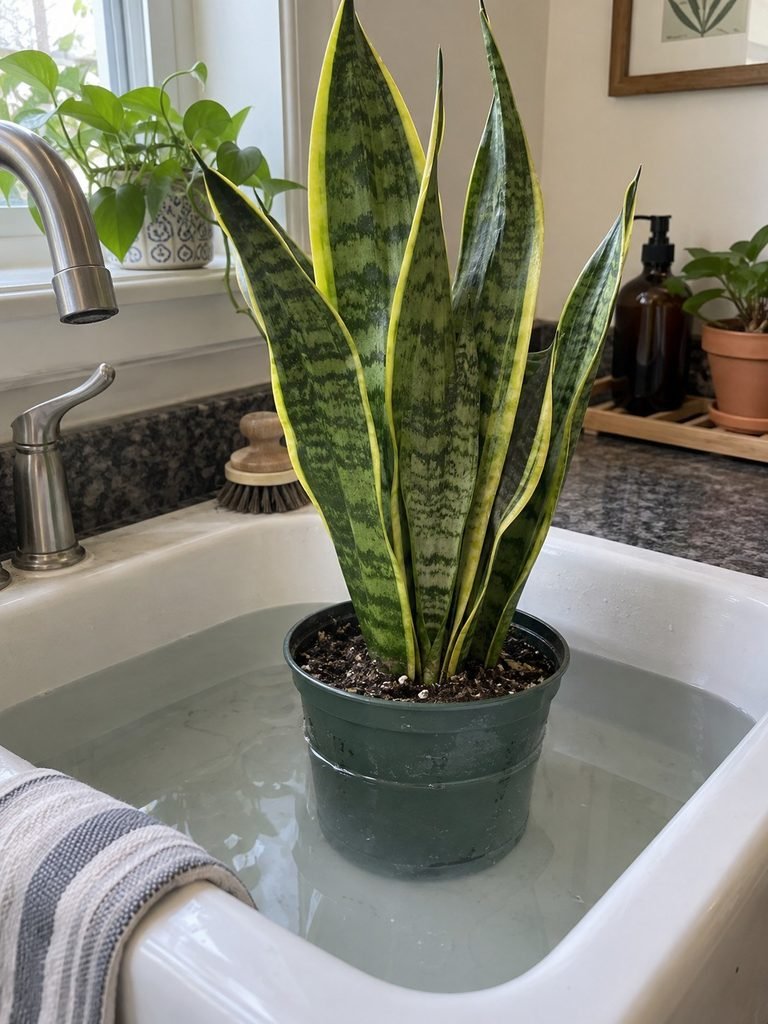
What to expect: leaves begin firming up within two to five days. Severely dehydrated leaves may never flatten completely, which is covered in the recovery section below.
RELATED: Snake Plant Care Guide: Light, Water, Soil and Pots
2. Overwatering and root rot
The more dangerous cause, and the one people misread most often.
Roots sitting in wet soil run out of oxygen, and fungal pathogens take hold. Rotted roots cannot move water into the plant, so the leaves show every sign of thirst while the soil is soaking. This is why watering a curling snake plant without checking the soil is such a common way to kill one.
What you will see: soft limp curling rather than stiff rolling, yellowing that starts at the leaf base, leaves that feel squashy near the soil, a sour or musty smell from the pot, soil still wet many days after watering, sometimes fungus gnats.
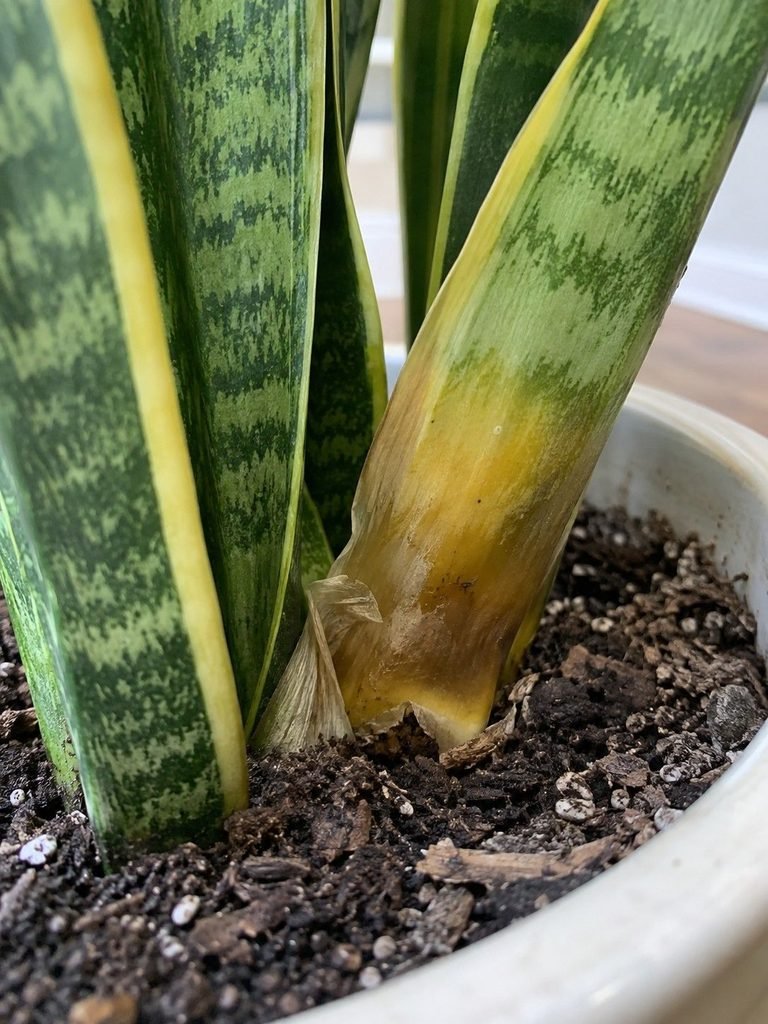
How to fix it:
- Stop watering completely.
- Empty the saucer or decorative outer pot. Standing water guarantees the problem continues.
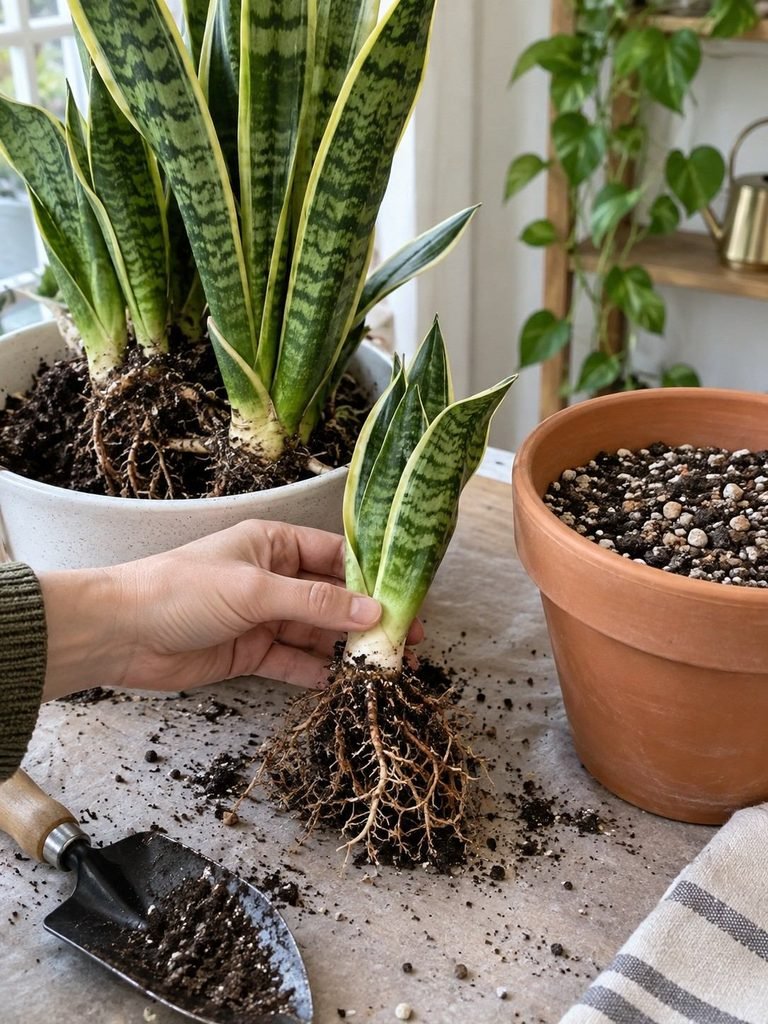
- Unpot the plant and rinse the roots under lukewarm water so you can see them. Healthy roots are firm and pale cream to tan. Rotted roots are brown or black, slimy, and fall apart when touched.
- Cut away every rotted root and any mushy section of rhizome with sterilised scissors. Cut back to firm tissue.
- Let the cut surfaces air dry for a few hours.
- Repot into fresh dry gritty mix, in a pot only slightly larger than the root system.
- Wait a week before watering, then water sparingly.
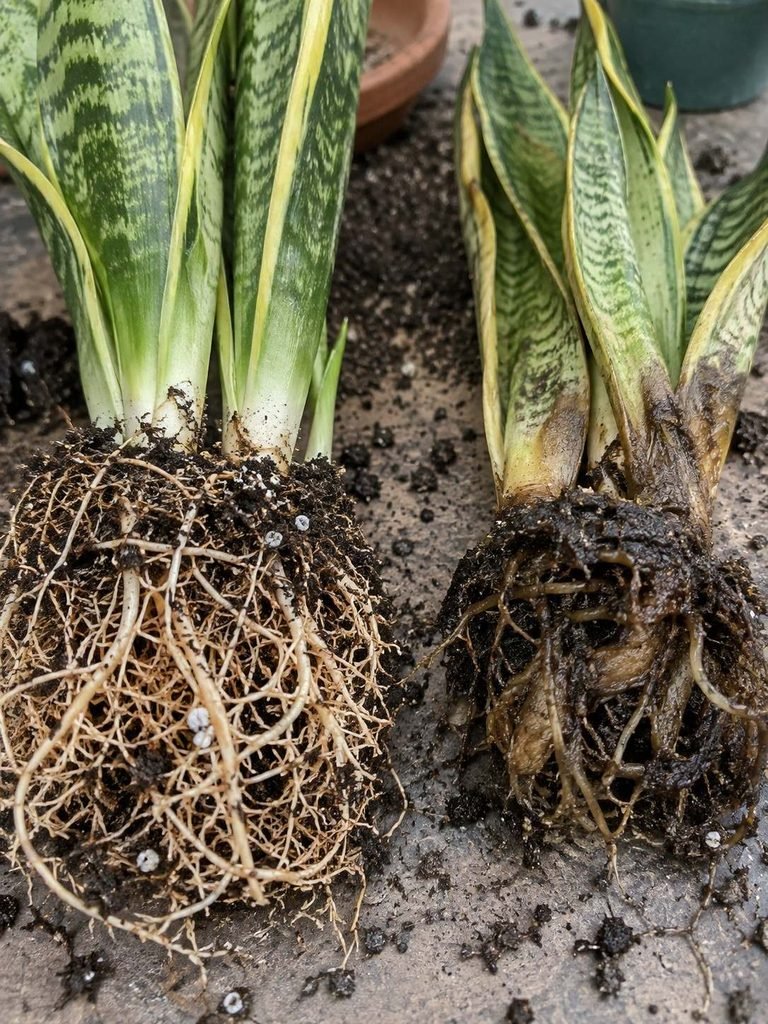
If the rhizome itself has gone soft throughout and leaves lift out with no resistance, the plant is unlikely to recover. Skip to the propagation section.
3. Pests, usually thrips or spider mites
Less common on snake plants than on softer leaved houseplants, but distinctive when it happens.
Sap feeding pests damage developing tissue, so new growth emerges deformed. The result is asymmetric twisting rather than the even lengthwise roll you get from water problems.
What you will see: twisted or puckered new leaves, silvery streaks or stippling, tiny dark specks of frass, fine webbing where leaves meet at the base, and small moving specks if you look closely. Check where leaves overlap at soil level, which is where they hide.
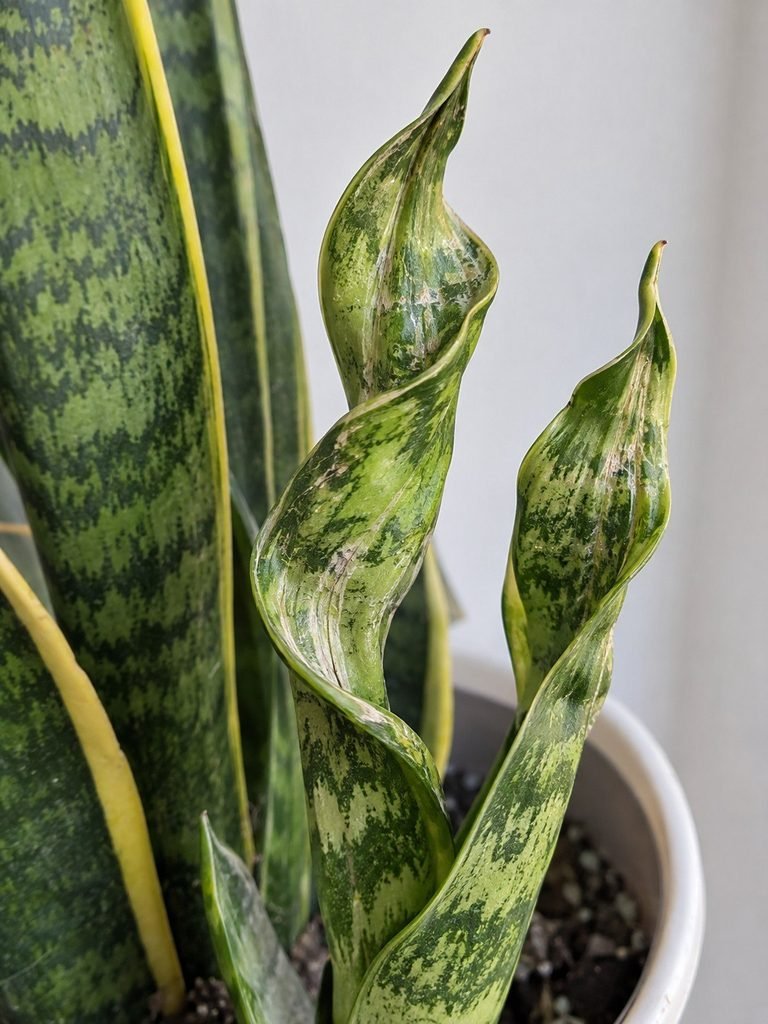
How to fix it: isolate the plant from your others immediately. Wipe every leaf on both sides with insecticidal soap or diluted dish soap. Repeat every five to seven days for at least three weeks, because most treatments do not kill eggs and you need to catch each hatch. Neem oil works well as a follow up. Already distorted leaves will not straighten, but new growth should come in clean.
4. Too much direct sunlight
Snake plants tolerate a wide range of light, but strong direct sun is a different matter.
In intense afternoon sun the plant loses water through its leaves faster than the roots can replace it, and curling is the plant reducing its exposed surface area. Bear in mind the instinct here is to water more, and that is the wrong move. The problem is light, not moisture.
What you will see: curling combined with pale, bleached or yellowed patches, usually worst on the side facing the window, sometimes with dry papery areas.
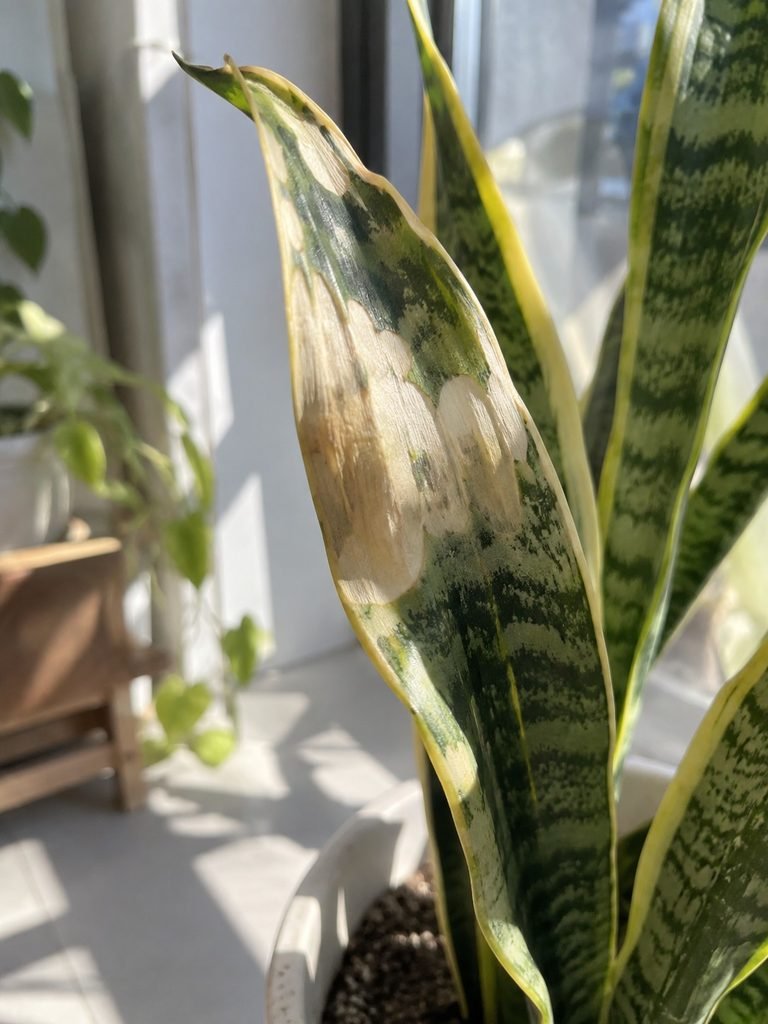
How to fix it: move the plant back from the glass, or filter the light with a sheer curtain. Bright indirect light is ideal, and a north facing window or a few feet back from an east window suits it well. Move it gradually rather than in one jump, since a sudden change in light is itself a stress.
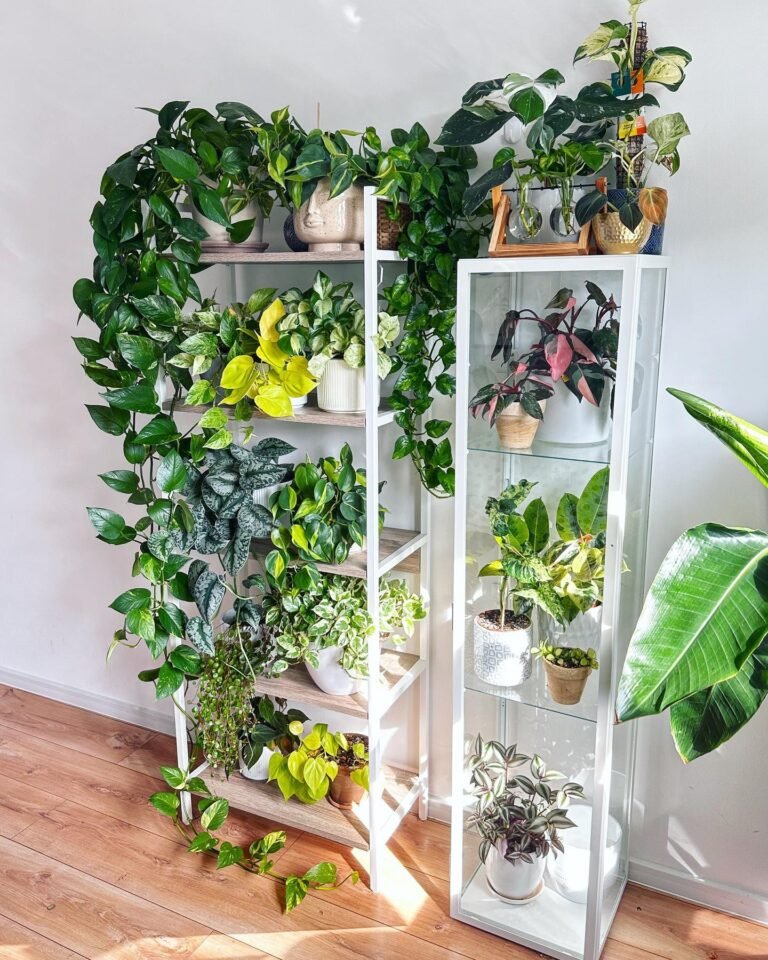
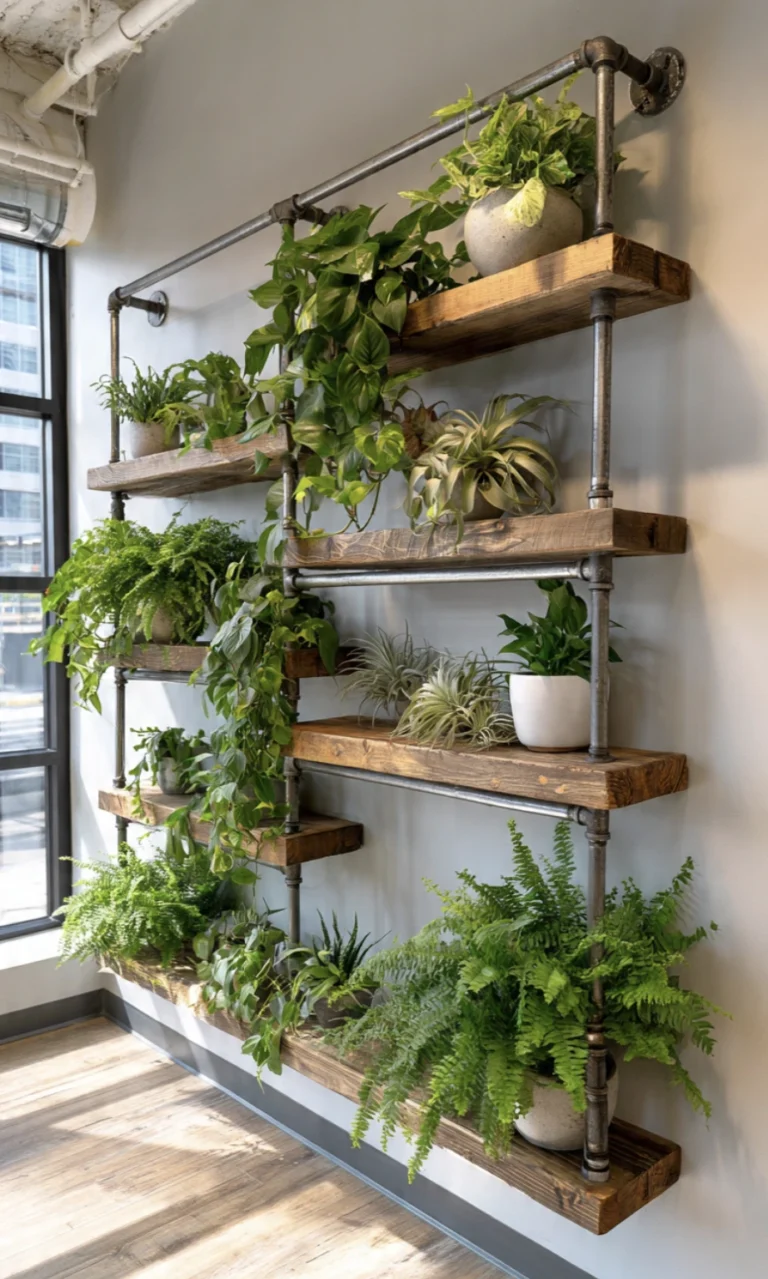
A shelf set back from the window works well, and our floating shelf ideas show several plant display setups.
5. Cold damage
Snake plants are tropical and suffer below about 50 degrees Fahrenheit. A single cold night against a winter window can do it.
What you will see: curling alongside dark, water soaked or mushy patches, often appearing suddenly rather than developing over weeks. Damage concentrates on the side nearest the cold source.
How to fix it: move the plant away from cold glass, drafty doors and unheated rooms. Cut off badly damaged leaves at the base, since they will not recover and can invite rot. Keep the plant somewhere stable between 65 and 85 degrees. Do not water more, because a cold damaged plant uses very little.
6. Root bound, or the wrong pot
Snake plants tolerate being snug, and mild crowding is fine. Severe crowding is not.
When roots and rhizomes fill the pot completely there is almost no soil left to hold moisture. Water runs straight through, the plant dries out within a day or two, and you get chronic mild dehydration that shows as curling despite regular watering.
What you will see: roots or rhizomes visible at the surface or pushing through drainage holes, sometimes a cracked or bulging plastic pot, water running out in seconds, soil drying almost immediately, and stalled growth.
How to fix it: repot in spring or early summer into a container one to two inches wider. Not more, because a much larger pot holds wet soil the roots cannot reach and pushes you toward rot. Snake plants also do well in heavier pots simply because tall leaves make light pots tip over. If you are choosing a container, our planter box ideas cover indoor options with proper drainage.
7. Fertiliser burn
Over feeding is rarer than the other causes but worth ruling out if nothing else fits.
Excess mineral salts in the soil pull water out of the roots rather than letting it in, which produces the same water stress as a dry pot.
What you will see: curling with browning leaf tips and edges, white or yellowish crust on the soil surface or around the pot rim, and a recent history of feeding.
How to fix it: flush the pot thoroughly with plain water, letting several pot volumes run through the drainage holes to carry the salts out. Then leave it unfed for at least three months. Snake plants need very little, so feed at half strength only two or three times across spring and summer, and never in autumn or winter.
When curling is just the variety
Before you treat anything, make sure your plant is not simply the shape it is meant to be.
Sansevieria cylindrica, sold as cylindrical or African spear snake plant, has round tubular leaves often braided or fanned. These are not flat leaves that have curled.
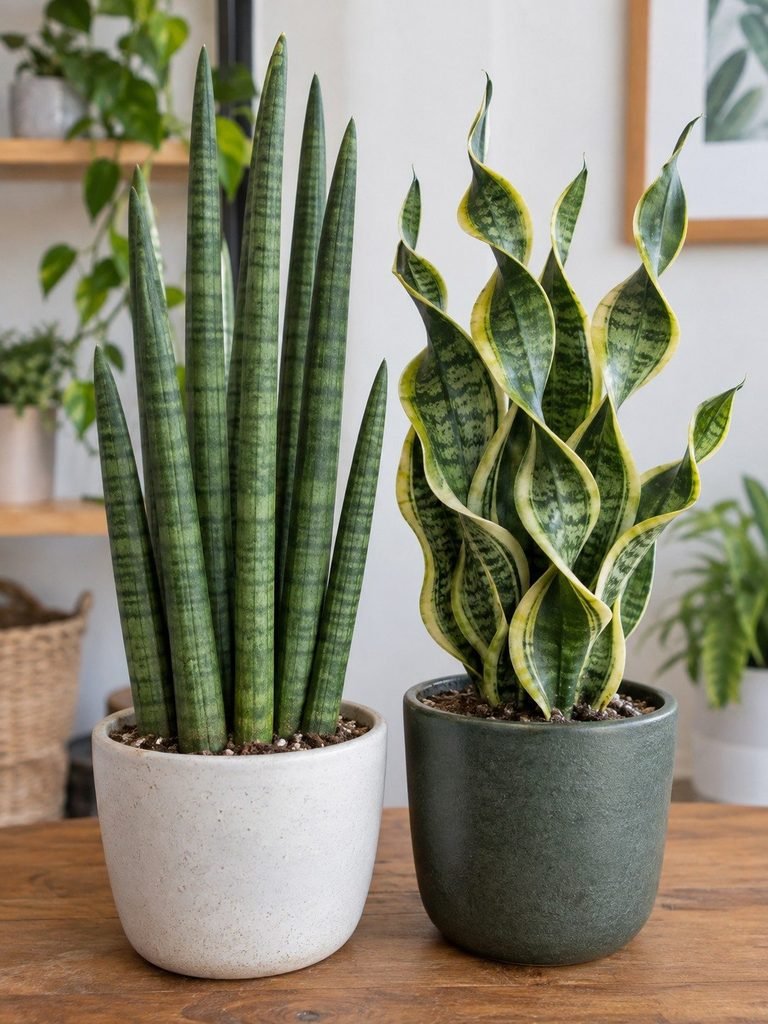
Twisted sister, a common cultivar, has leaves that spiral and wave naturally along their length.
Bantel’s sensation and several variegated cultivars have subtle waviness built in.
The distinction is straightforward. Natural shape is symmetrical, consistent across the whole plant, present from the day you bought it, and comes with firm leaves and healthy colour. A problem appears over time, affects some leaves more than others, and usually brings yellowing, softness or browning with it.
If your plant has always looked like this and is otherwise firm and growing, nothing is wrong. Snake plant also appears on our list of easy indoor plants for the home, where the common varieties are pictured side by side.
Change one thing at a time
This is the mistake that turns a recoverable plant into a dead one, and almost no guide warns about it.
The natural response to a struggling plant is to fix everything at once: water it, move it to better light, repot it, feed it and spray for pests in the same afternoon. Every one of those is a stress in itself. Stack five together and the plant is dealing with five disruptions on top of the original problem, and you have no way of knowing what helped or what hurt.
Make one change, then wait. Give it seven to ten days before assessing. A snake plant is slow, and its response to a correct change takes at least that long to show.
The only exception is active root rot or a spreading pest outbreak, where repotting or treatment cannot wait.
A useful sequence when you are unsure: correct the watering first, wait ten days, then adjust light, wait again, and only repot if the plant still is not responding.
What recovery actually looks like
Snake plants recover slowly, and people often conclude the fix failed when it is simply working at the plant’s own pace.
Days 1 to 5. After correcting underwatering, leaves firm up noticeably and partially unroll. After correcting overwatering, expect nothing visible at all. Wet soil takes time to dry and rotted roots take time to regrow.
Week 2. The key signal is that no new leaves are curling. That is progress even when nothing looks better.
Weeks 3 to 6. New growth appears from the centre of the plant. On a snake plant this is a slow pointed spear pushing up. This is your confirmation the plant has stabilised.
Months 2 to 6. New leaves reach full size, flat and upright. Old damaged leaves stay as they are.
Be realistic about the old leaves. A leaf that curled badly from dehydration will usually soften and partly relax but rarely returns to fully flat. A leaf damaged by rot, cold or pests will not recover at all. Recovery means the plant produces healthy new growth, not that the damaged leaves repair themselves.
If a curled leaf bothers you, cut it off at soil level with clean scissors once the plant has stabilised. Do not remove more than about a third of the foliage at once.
Why this happens most in winter
Curling complaints cluster from November to February, and three things change together.
Light drops, so the plant grows more slowly and uses less water. Indoor heating dries the air and can bake plants sitting near a radiator or vent. And cold drafts from windows and doors become common.
The result is contradictory: the soil stays wet far longer because the plant is drinking less, while the air around the leaves gets much drier. So you can get dehydration symptoms in leaves while the roots are actually too wet, which is the most confusing version of this problem.
What to do from late autumn: water far less often, every four to eight weeks is normal, and always by soil check. Stop feeding entirely. Move the plant away from radiators, vents and cold glass. Expect no new growth until spring and do not interpret that as failure.
Other houseplants show winter stress differently, and yellowing pothos leaves are the most common version of it.
When to stop trying and propagate instead
Sometimes the plant is beyond saving, and it is better to know that than to nurse it for six months.
If the rhizome at soil level is soft throughout, leaves lift out with almost no resistance, and the base smells sour, the root system has gone. No amount of correct watering brings that back.
The good news is that snake plants propagate from a single healthy leaf. Look for any leaf that is still firm and well coloured, even if the rest of the plant has collapsed.
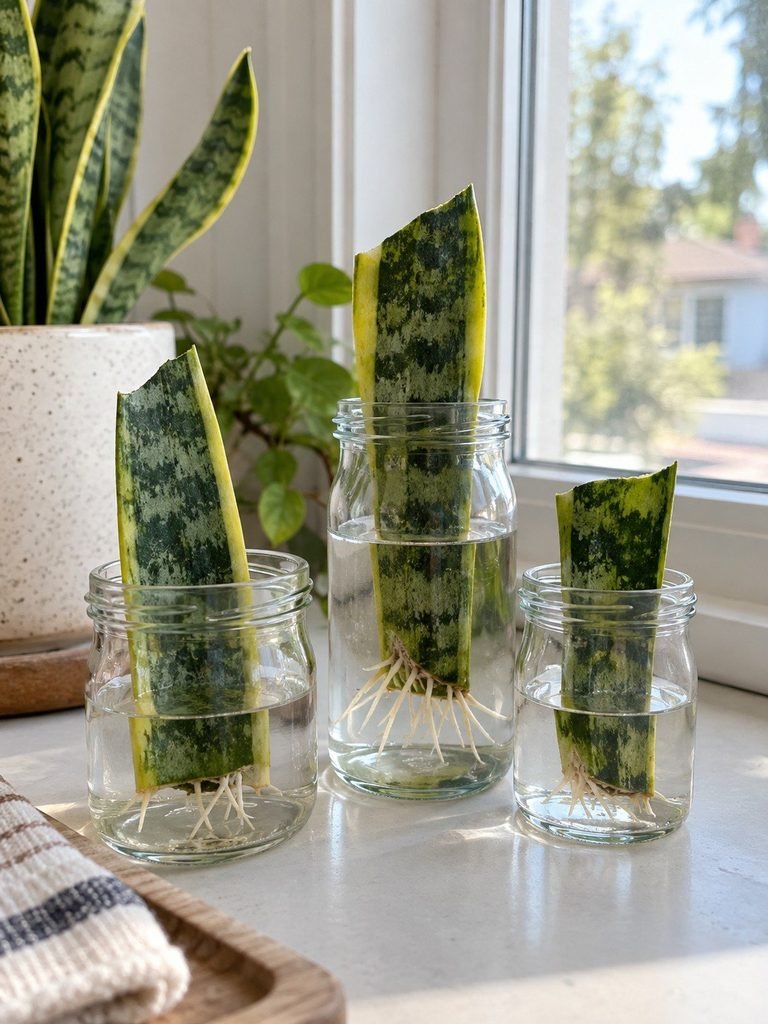
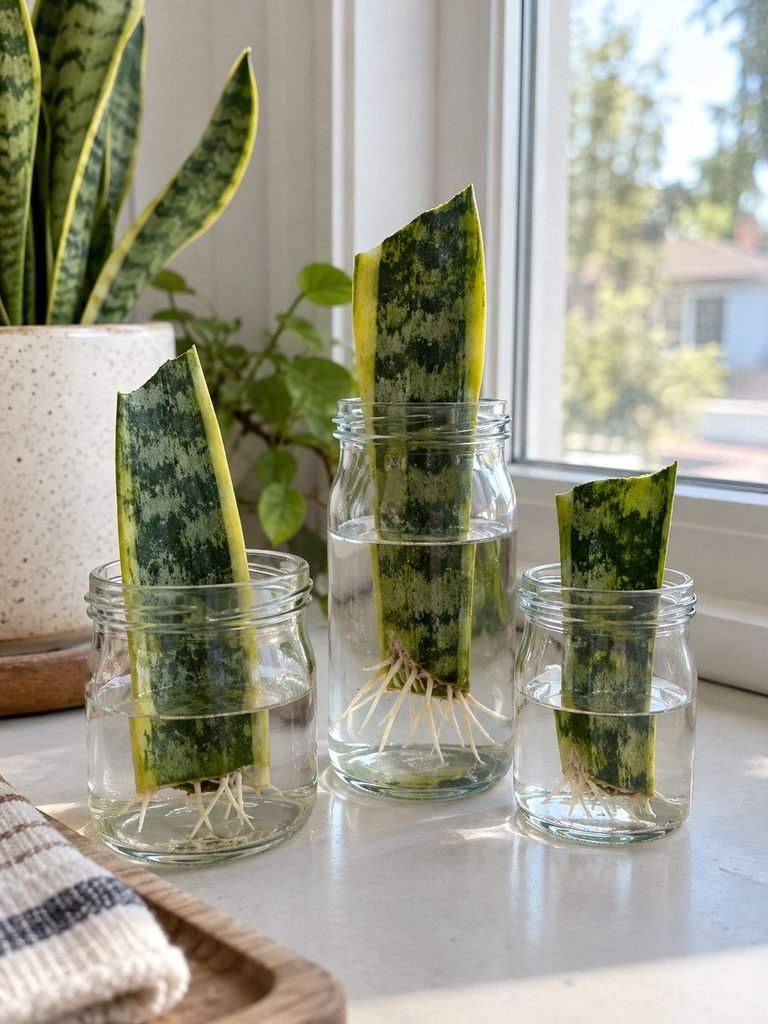
Cut a healthy leaf at the base, then cut it into three or four inch sections, keeping track of which end pointed down, because a section planted upside down will never root. Let the cut ends callus for one to two days, then stand them in a jar of shallow water or push them an inch into gritty mix. Roots take four to eight weeks, and new pups follow after that.
One thing to know first: variegated snake plants propagated from leaf cuttings usually lose their variegation and come back plain green. To keep the pattern you must divide the rhizome instead, which requires a healthy rhizome. If yours has rotted, take the leaf cuttings and accept the colour change, or start again with a new plant.
FAQs
Will curled snake plant leaves go back to normal?
Partly. Leaves curled from dehydration usually relax within days of a deep soak but often stay slightly rolled. Leaves damaged by rot, cold or pests will not recover. Judge success by healthy new growth rather than by old leaves.
Should I water my snake plant if the leaves are curling?
Only after checking the soil three inches down. Dry means water deeply. Wet means stop watering, because rotted roots produce the same curling as thirst and more water will make it worse.
How often should I water a snake plant?
Roughly every two to four weeks in spring and summer and every four to eight weeks in winter, but always by soil check rather than schedule. Snake plants tolerate drought far better than wet feet.
Why is only one snake plant leaf curling?
Usually localised damage, such as one leaf pressed against cold glass, sitting in direct sun, or knocked earlier. If the rest of the plant is firm and the soil is right, remove that leaf at the base and watch for a week.
Can a snake plant recover from root rot?
Often yes if the rhizome is still firm. Trim all rotted roots, repot in fresh dry gritty mix, and wait a week before watering. If the rhizome is soft throughout, propagate healthy leaves instead.
Does low humidity cause snake plant leaves to curl?
Rarely on its own. Snake plants come from dry regions and handle normal indoor air well. Very dry air near a radiator can contribute, but soil moisture is nearly always the real cause.
Why are my snake plant leaves curling and turning yellow?
Yellowing alongside curling points to overwatering rather than underwatering, especially when the yellowing starts at the leaf base and the leaves feel soft. Check the roots.
Is a curling snake plant dangerous to pets?
Snake plants are toxic to cats and dogs whether or not the leaves are curling, causing mouth irritation, drooling and vomiting if chewed.