Snake Plant Care Guide: Light, Water, Soil and Pots
Snake plants need bright indirect light, water only when the soil is dry all the way through the pot, and a gritty fast draining mix in a container with drainage holes. Water roughly every two to four weeks in summer and every four to eight weeks in winter, adjusting for how much light the plant actually gets.
Almost every guide opens by telling you the snake plant is nearly indestructible. That is true in the sense that it survives conditions which would kill most houseplants, but the phrase does real damage. It leads people to water a little every week, because the plant is supposedly forgiving, and it leads people to put it in a genuinely dark corner, because it supposedly tolerates anything. Those two habits together account for most dead snake plants.
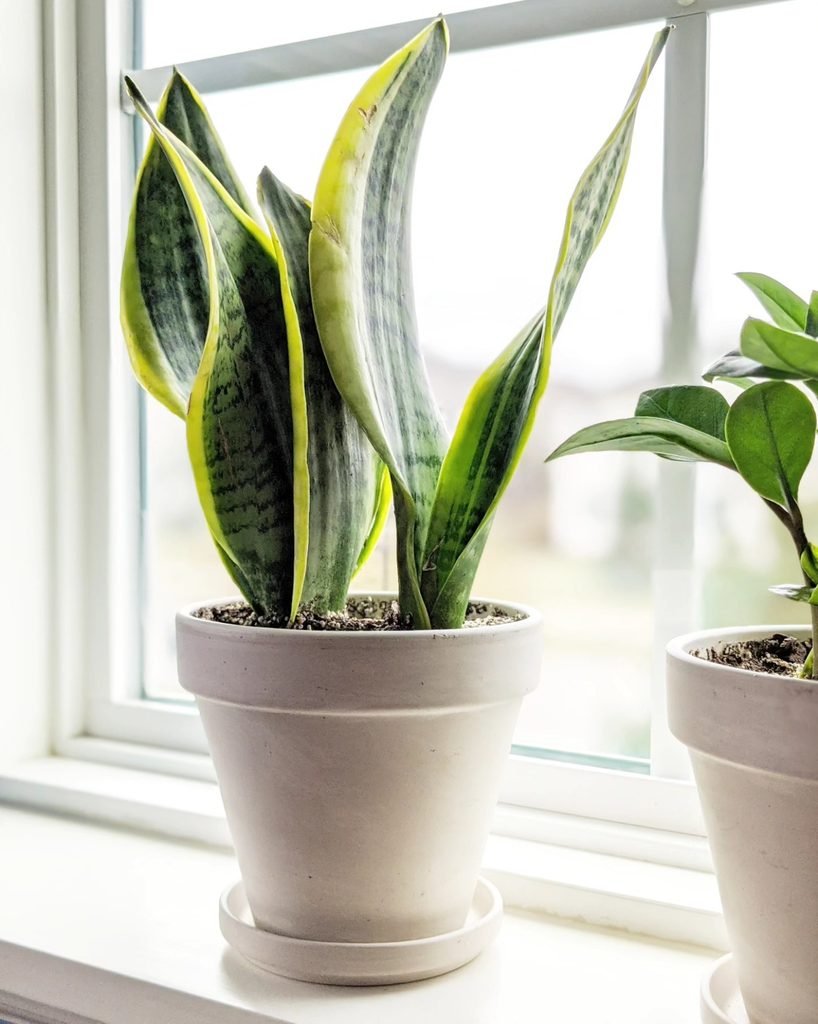
Here is the more useful framing. A snake plant will forgive you for forgetting it. It will not forgive you for being attentive in the wrong way. This guide covers care in the order that actually matters, gives you a watering method that works instead of a fixed number of weeks, and covers the nursery soil problem that catches almost every new owner.
Snake plant care at a glance
| Botanical name | Dracaena trifasciata, formerly Sansevieria trifasciata |
| Also called | Mother in law’s tongue, viper’s bowstring hemp |
| Light | Bright indirect. Survives low light with almost no growth |
| Water | Only when soil is dry throughout, every 2 to 4 weeks in summer |
| Soil | Gritty cactus or succulent mix, or potting mix cut heavily with perlite |
| Pot | Terracotta preferred, drainage holes essential, heavy base helps |
| Temperature | 60 to 85 degrees Fahrenheit. Damage below 50 |
| Humidity | Average household humidity. Tolerates dry air well |
| Feeding | 2 to 3 times across spring and summer, half strength |
| Growth rate | Slow. 2 to 4 new leaves per year in good light |
| Repotting | Every 3 to 5 years, or when the pot deforms |
| Toxicity | Toxic to cats, dogs and humans if chewed |
| Difficulty | Beginner |
The four things that matter, in order
Care advice usually arrives as a flat list where light, water, soil, humidity and feeding all look equally important. They are not, and knowing the order tells you where to put your attention.
- Soil and drainage. More snake plants die from sitting in dense wet soil than from every other cause combined. The mix the plant came in is often the problem.
- Watering by soil check, not by calendar. A fixed schedule is what turns a hardy plant into a rotted one.
- Light. Determines growth rate and colour intensity. Does not determine survival, which is why it is third rather than first.
- Pot choice. Material, drainage and weight. Matters more for this plant than for most because of its top heavy shape.
Humidity, misting and fertiliser sit below all four. Snake plants come from dry rocky regions of West Africa and handle normal indoor air without any help.
Soil, and the nursery mix problem
This section comes first because it is the single most useful thing you can act on, and almost no care guide leads with it.
Snake plants are commonly sold in dense peat heavy potting soil. That mix suits a nursery, where plants are watered on a controlled schedule in a bright greenhouse and turned over quickly. In an average home it is close to the worst possible medium, because it holds water for weeks and stays saturated at the bottom of the pot long after the surface feels dry.
You can water a snake plant perfectly and still lose it to rot if it is sitting in that soil.
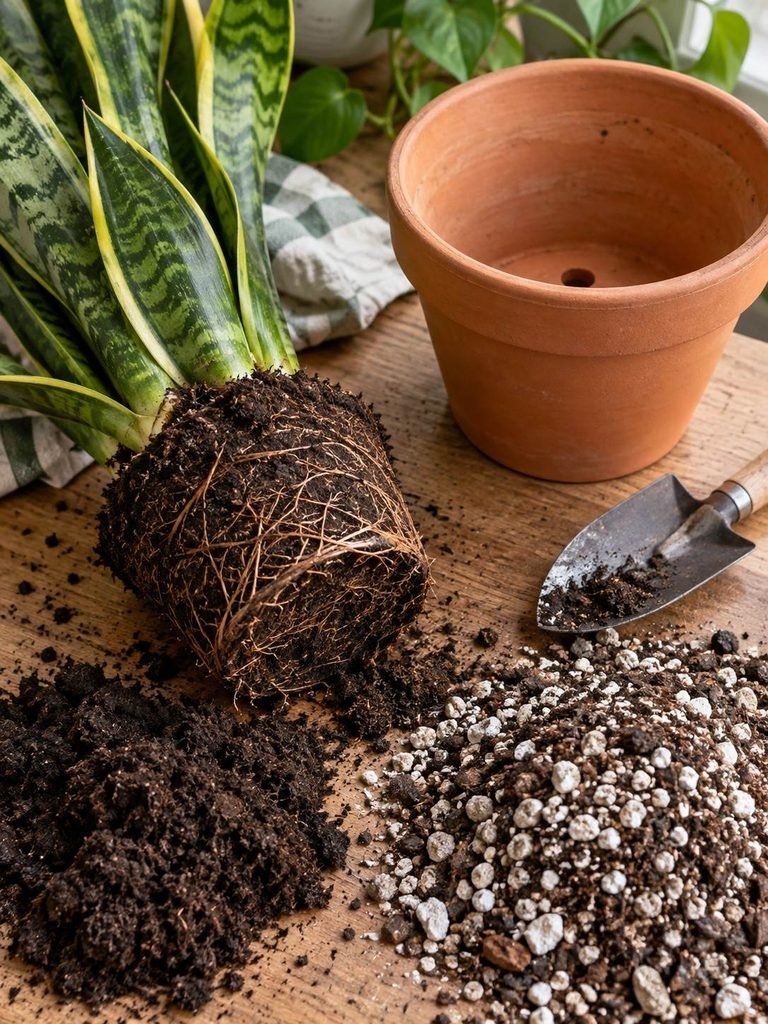
The mix you want: a cactus and succulent blend straight from the bag, or ordinary indoor potting mix cut with perlite, pumice or coarse sand at roughly one part grit to one part mix. It should feel loose and pour rather than clump. Water should run through within seconds rather than pooling on the surface.
When to change it. If your plant is new, wait until it has settled for three to four weeks, then repot into fresh gritty mix. If the plant is already struggling and the soil stays damp for more than a week after watering, repot now rather than waiting.
A test worth doing. Water the plant and note how long the soil stays damp three inches down. Under a week is fine. Over two weeks and the mix is holding too much for indoor conditions.
Water
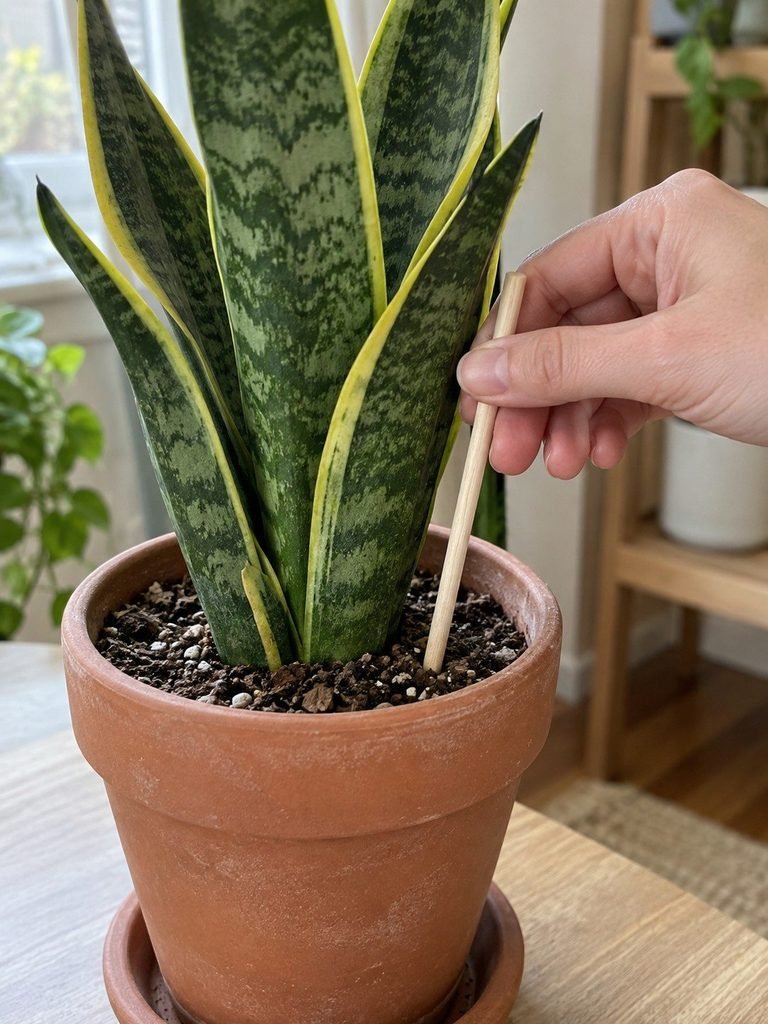
This is where the fixed interval advice fails, and where most guides let you down by giving a single number.
How to check. Push a finger or a clean wooden chopstick three inches into the pot, leave it ten seconds, and look at it. Dry and clean means water. Damp or dark means wait. Surface soil on a snake plant tells you almost nothing, because these are usually deep pots and the top few centimetres dry long before the root zone does.
Lifting the pot is faster once you know the plant. Wet soil is noticeably heavier, and the difference becomes obvious after a couple of waterings.
How to water. Thoroughly, until water runs freely from the drainage holes, then empty the saucer or outer pot within 30 minutes. Light sprinkles are worse than useless, because they keep the top damp while the roots stay dry and you never get a full wet to dry cycle.
How often, adjusted for conditions rather than a single number:
| Conditions | Summer | Winter |
|---|---|---|
| Bright light, small pot, terracotta | Every 10 to 14 days | Every 3 to 4 weeks |
| Bright light, large pot | Every 2 to 3 weeks | Every 5 to 6 weeks |
| Medium light, average pot | Every 3 to 4 weeks | Every 6 to 8 weeks |
| Low light, large pot, plastic or glazed | Every 4 to 6 weeks | Every 8 to 10 weeks |
The pattern behind the table is worth internalising. More light means more growth and faster drying. Bigger pot means more soil holding more water. Porous terracotta dries quicker than plastic or glazed ceramic. Winter slows everything down.
The rule that overrides all of it: when in doubt, wait. A snake plant recovers from a fortnight of thirst in a few days. It may never recover from a fortnight of wet roots.
If leaves are already rolling inward or going soft, our guide to snake plant leaves curling covers how to tell dry roots from rotted roots before you act, because the fix is opposite for each.
Light
Snake plants have the widest light tolerance of any common houseplant, and that tolerance is routinely oversold.
Bright indirect light is where the plant actually performs. An east facing window, or a few feet back from a south or west window. Expect two to four new leaves a year, strong variegation, and firm upright growth.
Medium light works fine. Growth slows to perhaps one or two leaves a year.
Low light is where the plant survives and does very little else. It will stay alive in a hallway with no window for years, but it will produce almost no new growth, variegation fades, and the soil dries so slowly that your watering interval has to stretch dramatically. That last point catches people out constantly.
Direct sun is tolerated if the plant is acclimated to it gradually, and some varieties handle a lot of it. Move a plant straight from a dim corner into a hot south window and the leaves bleach and curl.
So the honest version is this. Buy a snake plant for a dark room if you want something living that will not die there. Do not buy it expecting it to grow. If you want visible growth, give it real light.
Varieties differ here too. Moonshine and other pale cultivars need more light to hold their colour. The classic green Laurentii and Zeylanica are the most tolerant of dim conditions.
Pots, and why snake plants fall over
A section nobody writes, and a problem everybody with a large snake plant eventually has.
Snake plant leaves are tall, stiff and vertical while the root system is comparatively shallow. The centre of gravity sits high. Put a mature plant in a light plastic nursery pot and it will tip over, usually onto a hard floor, usually snapping several leaves.
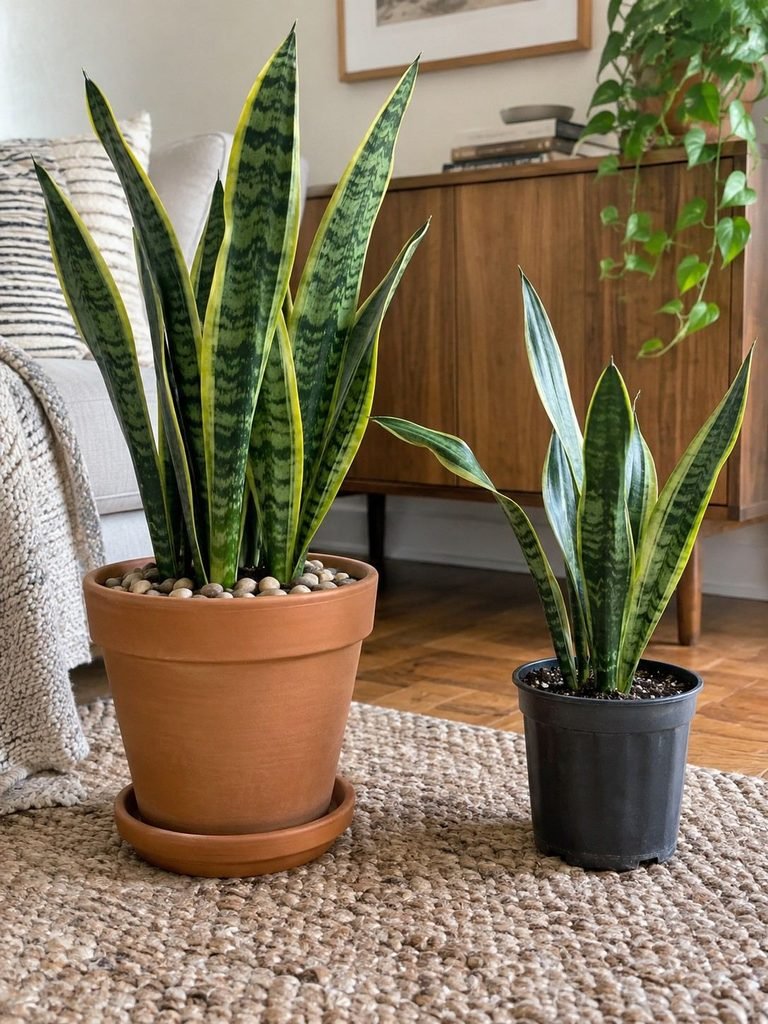
What to choose:
- Terracotta is ideal on two counts. It is porous, so it wicks moisture out of the soil and pulls the plant away from rot risk, and it is heavy enough to counterweight the leaves.
- Drainage holes are not optional. If you want a decorative pot without them, keep the plant in a plastic nursery pot inside it and lift it out to water. Never let it sit in collected water.
- Size up by one to two inches only. A much larger pot holds a mass of wet soil the roots cannot reach, which is the fastest route to rot.
- Snug is fine. Snake plants tolerate being crowded better than most plants and often flower when slightly root bound.
If you are choosing a container, our planter box ideas cover indoor options with proper drainage.
Watch for one specific sign that a repot is genuinely overdue: a plastic pot that has visibly bulged, cracked or gone oval. Snake plant rhizomes are strong enough to deform a pot from the inside, and that means the roots have no soil left to work with.
Temperature and humidity
Comfortable between 60 and 85 degrees Fahrenheit, which is ordinary indoor temperature almost everywhere.
Below about 50 degrees the leaves develop dark water soaked patches and the damage is permanent. In practice that means keeping the plant away from cold winter glass, drafty exterior doors, and unheated rooms and porches.
Also keep it away from the opposite extreme. Directly above a radiator or in the path of a heating vent, the leaves dry and brown at the edges.
Humidity requires no attention at all. Snake plants are adapted to arid conditions and average household air suits them. Misting does nothing useful and, on a plant this prone to rot, water pooling in the tight crevices where leaves meet at the base is actively risky. Do not mist.
Feeding
Very little, and less than you think.
Two or three feeds spread across spring and summer is enough, using a balanced liquid houseplant fertiliser at half the recommended strength. A slow release granular feed applied once in spring works equally well.
Stop entirely in autumn and winter, when the plant is barely growing and cannot use it.
Two rules. Water first, then feed, because fertiliser on dry roots burns them. And never feed a plant that is already struggling, since damaged roots cannot absorb nutrients and the extra salts increase the stress.
Signs you have overfed are white or yellowish crust on the soil surface, browning leaf tips and edges, and curling. The fix is to flush the pot with several volumes of plain water and then leave it unfed for several months.
The first month with a new snake plant
Nursery conditions are better than your home in every respect: higher light, controlled watering, regular feeding. A plant needs time to adjust to the drop, and the first month is when most new plants quietly begin to decline.
Week 1. Put it in its permanent spot and do nothing else. Do not water unless the soil is dry three inches down, which it may well not be, since nurseries water before shipping. Do not repot. Do not feed.
Week 2. Check where the leaves meet at soil level and along both sides of each leaf for pests. Nursery plants sometimes arrive with thrips or mites, and early treatment is far easier than late.
Weeks 3 to 4. If the plant looks stable, this is the moment to repot into gritty mix if it came in dense soil. Do it once, properly, and then leave it alone.
Resist repotting on day one. Repotting is a stress in itself, and stacking it on top of the move from nursery to home is a common way to lose a healthy plant.
How snake plants actually grow
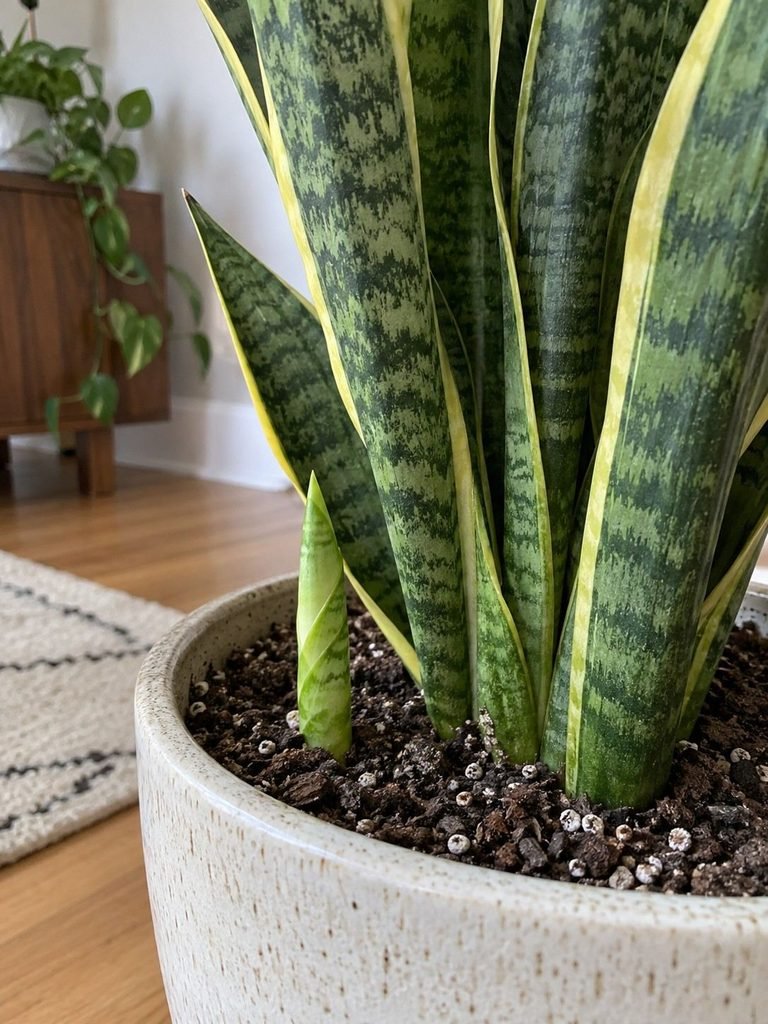
Understanding this changes how you interpret what the plant is doing.
Snake plants grow from rhizomes, thick horizontal underground stems. New leaves emerge as pointed spears pushing up from those rhizomes, usually near the edge of the existing cluster rather than from the centre. Over time the rhizome spreads sideways and fills the pot.
Three practical consequences.
Growth is slow and comes in bursts. Two to four leaves a year in good light is normal. Months with no visible change are not a problem.
New leaves emerge at full length potential but grow upward slowly. A spear can take several weeks to reach its final height. It will not thicken or branch.
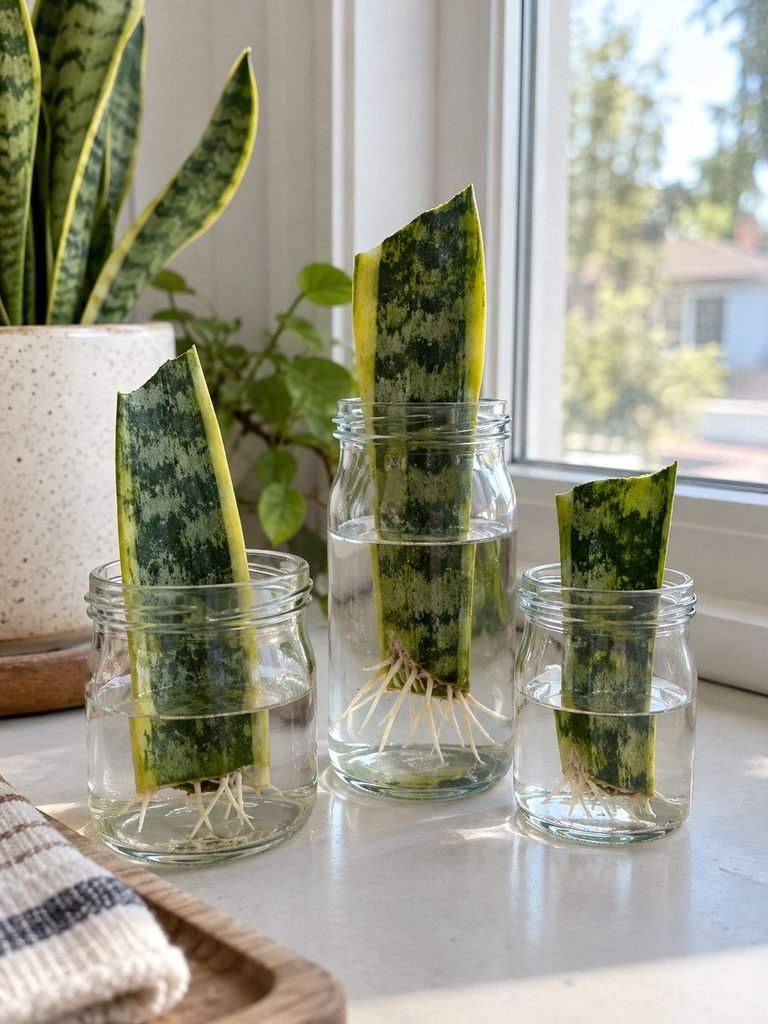
The plant multiplies by pups. Small offsets appear beside the parent, connected underground. These can be separated once they are a few inches tall and have their own roots, which is the easiest form of propagation and the only one that preserves variegation.
That last point matters. Leaf cuttings root readily but variegated varieties propagated from leaf sections come back plain green, because the variegation lives in the parent tissue rather than in the cells that regenerate. If you want more Laurentii with its yellow edges, you must divide, not cut.
Yes, snake plants flower
Most owners never see it, and those who do usually assume something has gone wrong.
A mature snake plant occasionally sends up a tall thin flower spike from the base, carrying dozens of small greenish white tubular blooms. They open in the evening, smell strongly sweet, and produce sticky nectar droplets that can drip onto the leaves and the surface below.
Flowering tends to happen when the plant is slightly stressed in a productive way, typically when it has been root bound in the same pot for years in good light. It is not a sign of illness and it is not a sign you should repot immediately. If anything it means your conditions have been consistent for a long time.
The bloom lasts a few weeks. Cut the spike at the base once it fades, since it will not rebloom and the plant redirects energy back into leaves. Wipe any nectar off the leaves, because it attracts pests and encourages sooty mould if left.
Cleaning the leaves
A small job with a measurable effect, and one of the few pieces of routine maintenance a snake plant genuinely benefits from.
Snake plant leaves are broad, flat and vertical, which makes them efficient dust collectors. A layer of dust physically blocks light from reaching the leaf surface, and on a plant already living in modest light that loss matters.
Wipe both sides of each leaf with a damp cloth every month or two, supporting the leaf with your other hand so you do not bend it. Skip leaf shine products, which clog the pores the plant breathes through.
Does a snake plant produce oxygen at night?
This claim appears everywhere, usually as a reason to keep one in a bedroom, and it deserves a straight answer.
The underlying botany is real. Snake plants use crassulacean acid metabolism, a photosynthetic pathway found in many arid climate plants, which means they open their pores at night rather than during the day to reduce water loss. So yes, some gas exchange happens overnight, unlike most houseplants.
The practical significance is close to zero. The quantity of oxygen involved is tiny relative to the volume of air in a room and the exchange from ordinary ventilation. You would need an implausible number of plants for it to register on the air you breathe.
The same applies to the broader air purification claims. Those trace back to a NASA study from the late 1980s that used small sealed chambers, conditions nothing like a house. Later analysis found you would need somewhere in the region of 10 to 1,000 plants per square metre to match simply opening a window.
Keep a snake plant in a bedroom because it looks good, needs almost nothing from you, and tolerates the low light bedrooms often have. Those are genuine reasons. Improved air is not one of them, and any guide leading with it has not checked.
Common varieties and what they need
| Variety | Appearance | Light |
|---|---|---|
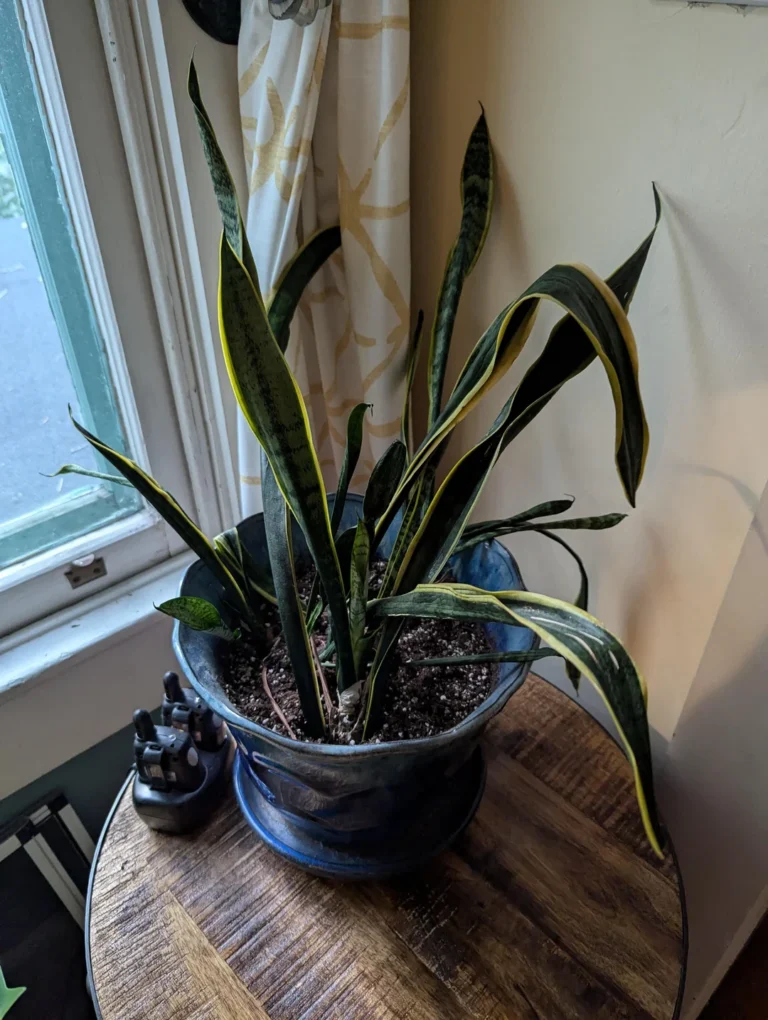
| Laurentii | Dark green with yellow edge stripes | Adaptable, brighter keeps the yellow strong |
| Zeylanica | Wavy grey green banding, no yellow edge | Most tolerant of low light |
| Moonshine | Pale silvery green, broad leaves | Needs bright light or it darkens |
| Cylindrica | Round tubular leaves, often braided | Bright indirect |
| Hahnii, bird’s nest | Short rosette, 6 to 8 inches tall | Adaptable, good for small spaces |
| Twisted sister | Spiralling wavy leaves, gold edges | Bright indirect |
| Black coral | Very dark green, faint banding | Adaptable |
| Fernwood | Thin arching leaves in a fan | Bright indirect |
Choose Zeylanica or Laurentii for a dim room. Choose Moonshine only if you have real light to give it, because it fades to ordinary green without it.
RELATED: 37 Best Low Light Houseplants for Dark Rooms
Seasonal care
Spring. Growth restarts. Feed once at half strength. Best time to repot, divide and separate pups.
Summer. Peak growth. Water every two to four weeks by soil check. One more feed mid season. Watch for pests in warm weather.
Autumn. Growth slows. Stop feeding. Begin stretching watering intervals.
Winter. Near dormant. Water every four to eight weeks, sometimes less. No feeding. Move away from cold glass and heating vents. Expect no new growth at all and do not read that as failure.
The biggest winter mistake is keeping a summer watering routine. Less light and slower growth mean the soil stays wet far longer, which is why rot and leaf problems cluster from November to February.
Common problems at a glance
| Symptom | Most likely cause | First step |
|---|---|---|
| Leaves curling inward | Dry roots or rotted roots | Check soil three inches down before watering |
| Soft mushy base, yellowing | Root rot | Unpot, trim rotted roots, repot in dry gritty mix |
| Leaves falling outward, splaying | Too little light, or overwatering | Move brighter, check soil |
| Brown crispy tips | Heat, mineral buildup, or overfeeding | Flush the pot, move away from vents |
| Pale or faded colour | Not enough light | Move brighter, expect new growth to be truer |
| Dark water soaked patches | Cold damage | Move away from cold glass, remove damaged leaves |
| Silvery streaks, distorted new growth | Thrips or mites | Isolate, wipe leaves, repeat weekly for 3 weeks |
For curling specifically, which is the most common complaint, our guide to snake plant leaves curling covers all seven causes and how to distinguish them.
FAQs
How often should I water a snake plant?
Every two to four weeks in summer and every four to eight weeks in winter, but adjust for light and pot size and always check the soil three inches down first. In a dark room with a large pot it can be considerably less often.
Can a snake plant survive in a room with no window?
It will survive for a long time but will produce almost no new growth, and you must water far less often because the soil stays wet. A few hours of artificial room light helps.
Why is my snake plant falling over?
Usually either too little light, which weakens the leaves, or a pot too light to counterweight tall foliage. Move it brighter and repot into terracotta or a heavier container.
Do snake plants need to be repotted often?
No. Every three to five years is typical. Repot when the pot deforms, when roots push out of the drainage holes, or when growth has stalled despite good conditions.
Should I mist my snake plant?
No. Snake plants are adapted to dry air, misting achieves nothing, and water pooling where the leaves meet at the base can encourage rot.
Why won’t my snake plant grow?
Almost always light. It survives in dim conditions but barely grows there. Also check whether it is winter, since no growth from November to February is normal.
Can I propagate a variegated snake plant from a leaf cutting?
You can root it, but the new plant will come back plain green. To keep yellow edges or pale colouring you must divide the rhizome or separate a pup instead.
Are snake plants toxic to pets?
Yes. They contain saponins and are toxic to cats and dogs, causing mouth irritation, drooling, vomiting and diarrhoea if chewed. They irritate humans too.